Make it thicker · silkier and better seasoned
–
More vegetables puts starch and body into the liquid, on top of the gelatin the meat gives up.
Costs you: No side effect showed up in the reviews.
strongest lever we measured · 357 bakes
75 recipes, read so you don't have to.
Every published pot roast recipe is a different answer to the same few questions. We resolved all 75 of them to grams, then read what cooks said happened when they changed something.
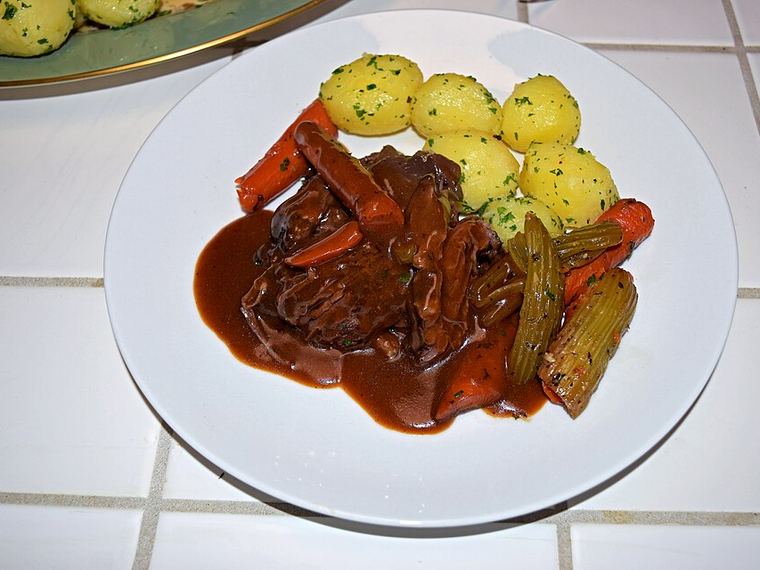
Nothing picked yet, so this is simply the most-trusted of the 75. Pick a style and the answer changes.
Weights are ours, converted from the published measures.
Pick the texture you want, or the problem you are having. Each one is a full page with the numbers behind it.
Two of these decide which style it is. The rest are just where this recipe has a personality of its own.
Every recipe in the same group, measured the same way. The shaded band is the middle half of the group; the line is its midpoint; the dot is this recipe.
Each one is measured across all 75 recipes and then converted into this recipe's own amounts. Every edit costs something. The cost is on the card.
Make it thicker · silkier and better seasoned
–
More vegetables puts starch and body into the liquid, on top of the gelatin the meat gives up.
Costs you: No side effect showed up in the reviews.
strongest lever we measured · 357 bakes
Make it milder
–
Costs you: No side effect showed up in the reviews.
strong lever · 262 bakes
Make it less salty
–
More braising liquid adds liquid the sauce then has to lose, so it finishes thinner unless you reduce it.
Costs you: No side effect showed up in the reviews.
strong lever · 218 bakes
Make it hotter
–
More aromatics survives the length of the cook -- which is why a slow cooker needs two to three times what a stovetop braise does.
Costs you: No side effect showed up in the reviews.
measurable lever · 265 bakes
Make it more tender
–
More salt gives the collagen longer to become gelatin, which is what makes the meat shred instead of chew.
Costs you: No side effect showed up in the reviews.
measurable lever · 679 bakes
One dot per published recipe, placed by what it is actually made of, not by what its title claims. Dots that sit together have near-identical formulas.
Positions are worked out from the formula, not measured in a kitchen. Good for comparing one recipe to another, not for reading an exact value.
What people actually changed, and what they said happened. Where cooks contradict each other we kept both sides rather than averaging them into something nobody said.
Use Better Than Bouillon beef base instead of a gravy mix.
13 cooks reported this
If the roast comes out too firm to pull apart despite following the recipe's stated time, the real cause is usually undercooking relative to cut size/collagen - add more time rather than trusting the clock.
10 cooks reported this
Sear/brown the roast on all sides before braising or slow-cooking for deeper color and flavor.
10 cooks reported this
Swap water for beef broth or stock as the braising liquid for a richer-tasting roast.
9 cooks reported this
Use beef broth or stock instead of water for more flavor.
8 cooks reported this
Sear/brown the meat thoroughly before braising for a more tender, moister roast.
6 cooks reported this
Brown the meat well and deglaze the pan before braising.
6 cooks reported this
Doctor up a mix-based gravy with sauteed mushrooms and onions.
6 cooks reported this
Strain the pan drippings and add cornstarch to make gravy.
46 cooks say yes · 3 say the opposite · we kept both
Extend the braising or roasting time well beyond the recipe's stated duration when the roast isn't yet fork-tender - collagen in tougher cuts needs the extra hours to break down.
32 cooks say yes · 6 say the opposite · we kept both
Add extra bouillon cubes and water to make more gravy.
4 cooks say yes · 17 say the opposite · we kept both
The counts on each card come from an earlier, smaller reading of the reviews. They undercount how many cooks said each thing, so treat them as a floor rather than a total.
Some ingredients are argued over from recipe to recipe. Others every author already agrees on. Knowing which is which saves you the experiment.
| Ingredient | What changing it does | Status |
|---|---|---|
| Braising liquid | More braising liquid adds liquid the sauce then has to lose, so it finishes thinner unless you reduce it. | recipes vary this |
| Butter | recipes vary this | |
| Aromatics | More aromatics survives the length of the cook -- which is why a slow cooker needs two to three times what a stovetop braise does. | recipes vary this |
| Acid | recipes vary this | |
| Sweetener pct | recipes vary this | |
| Salt | More salt gives the collagen longer to become gelatin, which is what makes the meat shred instead of chew. | recipes vary this |
| Thickener | More thickener puts starch and body into the liquid, on top of the gelatin the meat gives up. | recipes vary this |
| Vegetables | More vegetables puts starch and body into the liquid, on top of the gelatin the meat gives up. | recipes vary this |
| Connective tissue in the cut | More connective tissue in the cut gives the collagen longer to become gelatin, which is what makes the meat shred instead of chew. | recipes vary this |
| Marbling in the cut | More marbling in the cut converts the collagen faster but wrings the fibres harder -- tender sooner, drier sooner. | recipes vary this |
| Portion | recipes vary this |
Every change above works through one of these. None of it is magic and none of it needs a thermometer.
Connective tissue converts to gelatin above about 160F, fast above 180F, and is done by 195-205F. Gelatin coats the fibres, and that coating is what reads as succulent.
Muscle proteins tighten from about 120F and squeeze out water. This never stops and nothing puts the water back.
An open braise evaporates and concentrates; a sealed one does not. That single difference is most of what separates a Dutch oven from a slow cooker.
Dissolved collagen thickens the liquid on its own. A sauce that sets to a wobble when chilled had enough; one that stays watery did not.
Fat- and water-soluble compounds extract at different rates, and volatile herb compounds DEGRADE over a long cook. Eight hours destroys dried thyme.
Grouped by measured texture rather than by title, which is why a few recipes sit in a group their own name would not suggest. Sorted by how many cooks have rated them.
The useful half of any measurement is knowing where it stops.
We can say one recipe reads further along an axis than another. We cannot put a number on it, and we do not pretend to.
Where we can name something that measurably changes the result, we can say which way it pushes. We still cannot tell you where your own pot roast will land, because that also depends on your kitchen and your equipment. here is what we can tell you when it goes wrong.
A few publishers load their reviews from somewhere we cannot read. Their star ratings count toward how trusted a recipe is; their comments could not tell us anything about what cooks changed.