Troubleshooting

Cookie problems, diagnosed

Start with what went wrong. Every answer here is checked against 85 recipes rather than repeated.

Most troubleshooting advice is a list of plausible causes in no particular order, and the lists disagree with each other. We compared every published recipe we could resolve and read 7,124 reviews from cooks who changed one thing, so we can rank causes by evidence and say plainly which ones we cannot test.

10Symptoms covered
85Recipes compared
7,124Reviews read
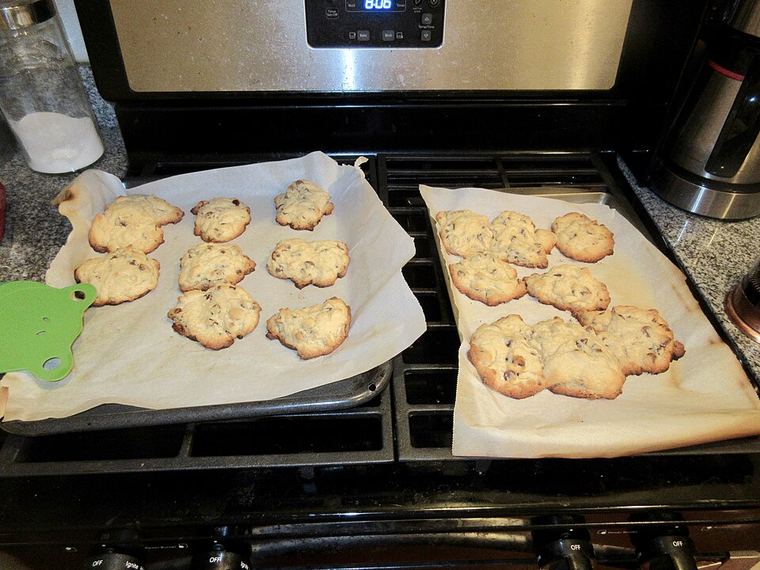
Chocolate chip cookies on a baking tray.
Infrogmation · CC BY-SA 4.0
Before you change the recipe

Three checks that come before any diagnosis

Most cookie problems are not formula problems. These three account for more bad batches than every ingredient argument combined.

Check first invisible in every recipe

Weigh the flour

A cup scooped from the bag can hold a third more than a cup spooned in and levelled.

This is the single most common cause of both flat and cakey cookies, in opposite directions, and it is the one thing our data can never see. Recipes record what they asked for, not what went in. If you change one habit, change this one.

What to do: 120 g per cup of plain flour, on a scale.

Check second 85 recipes compared

Know what your butter was doing

Cold, softened, melted and browned butter are four different ingredients, not four temperatures of one.

Butter is roughly a sixth water. Whether that water is locked in fat crystals or already free changes how much gluten forms before the tray ever reaches the oven. A recipe written for creamed butter will not behave if you melt it, and the reverse is just as true.

What to do: match the recipe's method before blaming its ratios.

Check third measured across the whole set

Portion by weight

Cookie size is a formula variable, not a serving choice.

Mass decides how far the edge dries out before the centre sets. A large cookie can be crisp at the rim and molten in the middle from exactly the dough that bakes uniformly at half the size, which means half of what looks like a recipe fault is a scoop fault.

What to do: weigh one portion, then match the rest.
Start here

What did yours do?

Pick the sentence closest to what came out of your oven. Where we have a full page, the short answer links to it; where we do not, the short answer is the whole answer and we say so.

“They spread into one flat puddle” flat · spread too much · thin and greasy Weigh the flour first. Butter is the one lever we actually measured against spread: warmer, softer butter bakes flatter and wider. Full diagnosis →
“They stayed in a dome and never spread” cakey · puffy · too thick · won't spread Usually too much flour. The leavening explanation you will read elsewhere is one we measured the opposite of. Full diagnosis →
“They went hard the day after” hard · dry · crumbly · won't stay soft Brown sugar holds water in the crumb after baking, and water is what keeps a cookie soft. A cookie built mostly on white sugar goes hard sooner however you store it. Full diagnosis →
“The middle was still raw” underbaked · doughy centre · when are they done Bigger cookies set at the edge long before the middle does. That gap is a property of size, not of your oven. Pull them when the edge is set and the centre still looks slightly wet. Full diagnosis →
“They came out pale” not browning · too light Browning runs on sugar and egg. More leavening makes these doughs paler rather than darker, which is the one result in our data that looks wrong and is not. Short answer only, no full page yet
“They taste flat, or oddly savoury” not sweet enough · tastes of baking soda Salt changes how sweet a cookie reads without changing its sugar. So does the amount of chocolate. Both are measured levers. Short answer only, no full page yet
“They came out greasy, with butter pooling” greasy · oily · butter separated Fat that melts before the structure forms has nowhere to go but out. This is usually butter that was too warm going in rather than too much butter in the recipe. Short answer only, no full page yet
“The bottoms burnt before the tops were done” burnt bottoms · dark underneath · pale on top A conduction problem, not a formula one: dark and thin trays run hotter against the dough than pale, heavy ones. Nothing in the recipe will fix a tray that is cooking the base too fast. Short answer only, no full page yet
“They came out different sizes and shapes” uneven · misshapen · some spread more than others Portion by weight rather than by eye. Cookie mass decides how far the edge dries before the middle sets, so two different-sized portions of one dough genuinely bake into two different cookies. Short answer only, no full page yet
“They were fine warm and disappointing cold” good out of the oven · bad an hour later · goes stale fast Almost every cookie is good warm. What survives cooling is decided by how much water the crumb holds on to, which is mostly the brown-to-white sugar ratio. Short answer only, no full page yet
Why the answers connect

Flat and cakey are the same problem, decided the other way

A cookie spreads for as long as its fat is liquid and stops the moment its structure sets. Everything that goes wrong with a cookie's shape is that one race, finishing too early or too late.

Which is why the two most-searched cookie problems have the same levers with the signs reversed, and why fixing one by overcorrecting is the usual route to the other. Nobody covering both seems to link them, so readers arrive at each page as though it were an unrelated fault.

How to read any answer here

Three rules we hold ourselves to

Direction, never dose

We can say which way a change pushes and which change pushes hardest. We cannot tell you how wide, how tall or how dark the result will be, and we will not guess.

“Untested” is not “disproved”

Some popular explanations have no comparison group in the published record at all. We say which, rather than quietly leaving them off the list or repeating them as fact.

The commonest cause is often invisible

Mis-measured flour probably causes more bad cookies than everything else combined, and no recipe records what actually went into the bowl. We flag it first and admit we cannot rank it.