Troubleshooting

Why are my cookies cakey and puffy?

Three causes get repeated everywhere. Two of them hold no evidence at all.

A cakey cookie is one that set before it spread. We compared 85 published recipes and read 7,124 reviews from cooks who changed one thing, which lets us check the usual explanations one at a time instead of repeating them.

3Causes checked
2That did not hold
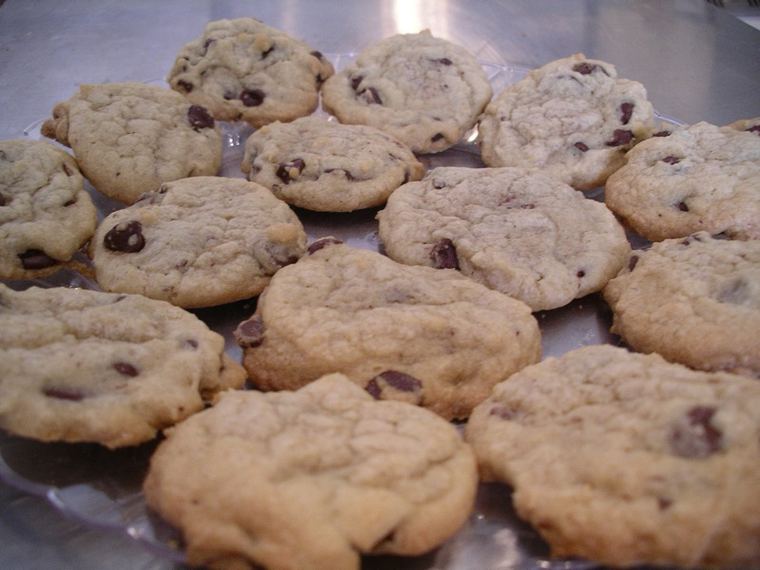
Pale, domed chocolate chip cookies that have not spread.
pjmorse · CC BY-SA 2.0
One cause at a time

The three things you will be told, checked

Listed in order of how sure we can be: the one we believe but cannot test, then the one nobody has ever tested, then the one we found no evidence for at all.

Almost certainly true, and we cannot test it not visible in any recipe

Too much flour

Almost certainly, and we cannot show it to you.

Every recipe we compared states a flour quantity. None of them record what the baker actually put in the bowl, and that gap is exactly where this problem lives: a cup scooped straight from the bag can hold a third more than a cup spooned in and levelled. We think the consensus is right. We are not going to pretend we measured it.

What to do: Weigh it. 120 g per cup is the usual assumption. This is the single highest-value change on this page.

Nobody has tested this, including us 0 of 85 use powder alone

Using baking powder instead of baking soda

We cannot say, and neither can anyone asserting it.

Of the 85 recipes we resolved, 0 use baking powder on its own. There is no group to compare against. Three separate pages state this as a cause; none of them show a comparison, and the published record does not contain one to make. The mechanism is plausible: powder carries its own acid and behaves differently. But plausible is not measured.

What to do: Treat this as an open question rather than a known cause.

We looked, and found nothing no measured link to spread

Too many eggs

Not that we can see. Egg varies a lot between these recipes and none of that variation showed up as spread.

Egg does have a clear, measured job in a cookie: it firms the middle and browns the cookie faster. It simply is not one of the things that decides how far the dough travels on the tray.

What to do: Add a yolk for a richer cookie if you want one. Do not remove egg to fix puffiness.
Tonight, with the dough you already have

The fastest fix changes nothing in the bowl

Before you adjust a formula: how you shape the dough moves thickness more immediately than any ingredient, and it is the one thing cooks do not argue about.

Level off your quarter-cup scoops and don't reshape the dough once it's on the sheet -- it spreads a bit more evenly.

9 cooks reported this

Baking thicker portions, oversized dough scoops, a deep pie plate, or a 9x13 pan instead of individual cookies, leaves the centers gooier since they don't cook through as evenly.

3 cooks reported this

Use smaller portions of dough for cookies that spread more; a full, well-packed quarter-cup scoop holds its shape and spreads less.

3 cooks reported this

Frozen dough balls from a doubled batch just need about 30 minutes to thaw before baking for about 12 minutes.

3 cooks reported this

Why it happens

Cakey is a race between spreading and setting

The dough spreads while its fat is liquid and stops when its structure sets. Anything that brings the setting forward, or slows the spreading, leaves you with a taller, softer, more cake-like cookie.

Gluten development

Flour protein plus available water plus agitation builds an elastic network that resists the bite.

Sugar-water competition

Sugar is hygroscopic in the dough too. It binds water and denies it to the flour, suppressing gluten.

Leavening and dough pH

Baking soda does two jobs: it makes CO2 with an acid, and it raises pH. Above about pH 8 the Maillard reaction speeds up sharply; below 7.8 it stalls and cookies stay pale.

Bake geometry

Mass and surface-to-volume decide how far the edge dries before the centre sets. Edge and centre are separately controllable, which is why a cookie can be crisp outside and soft inside without contradiction.

Honesty

What this page cannot tell you

The likeliest cause is invisible to us

Mis-measured flour is probably the biggest single reason, and our data can never see it. We say so rather than quietly ranking it.

Powder-only recipes do not exist here

0 of 85 use baking powder on its own, so the powder-versus-soda question has no comparison group in the published record. Not disproved: untested.

Direction, never dose

We can say which way each lever pushes and which pushes hardest. We cannot tell you how tall your cookie will be.