54 of the 85 recipes we compared

Soft & chewy chocolate chip cookies

Five things the internet says make a chewier cookie. We measured every one of them.

Dense, bending middle. Soft edge. Bends before it breaks. Below is the closest published recipe to the middle of that group. Then comes the part nobody else shows you: which of the usual advice actually survives contact with cooks who changed one thing and reported what happened.

2Tips that hold up
3That we could not find
54Chewy recipes
7,124Reviews read
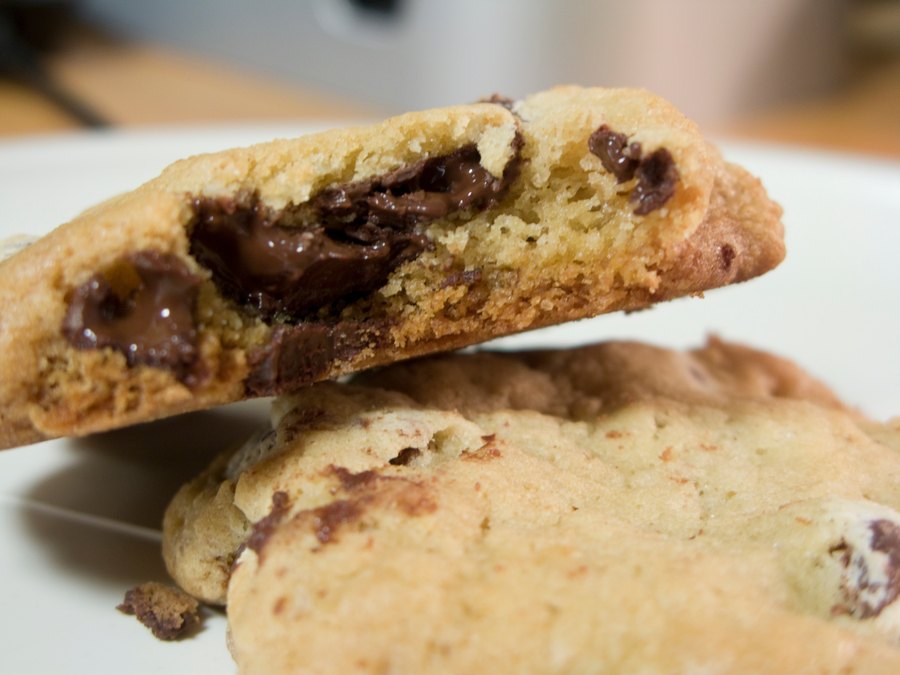
A chocolate chip cookie broken open, showing a soft molten middle.
Sam crockett · CC-BY
The pick

The closest recipe to the middle of chewy

Not the highest-rated cookie on the internet. The one whose formula sits nearest the centre of the 54 we measured as chewy.

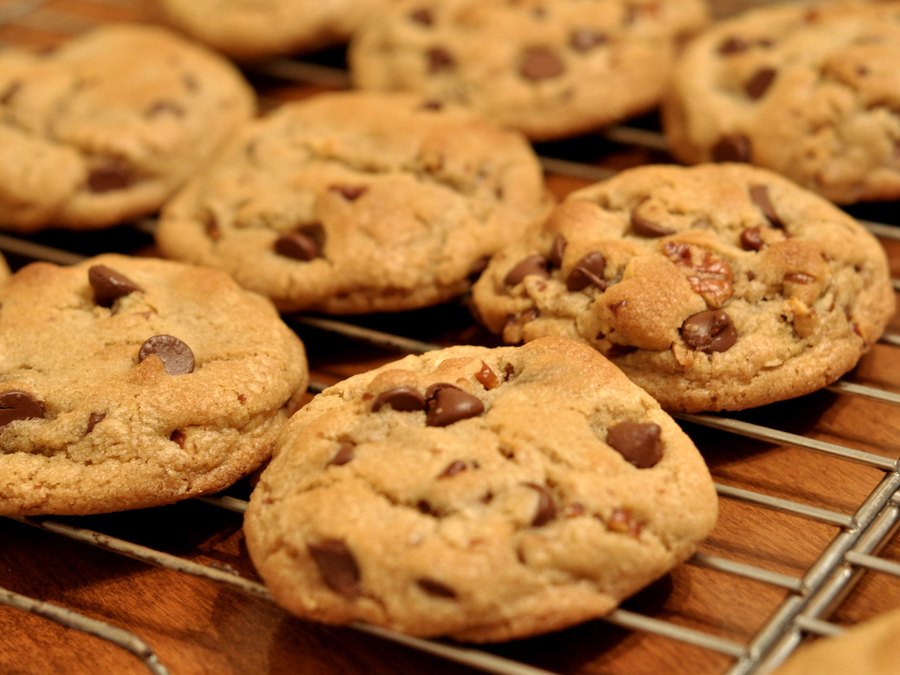
Finished chewy chocolate chip cookies cooling on a rack.
Best of the 54

The BEST Chewy Chocolate Chip Cookies

from asassyspoon.com 4.91 433 cooks rated it

Its total sugar sits high in the chewy group, which per the evidence below is the one lever that actually tracks with more chew. Its brown-to-white ratio lands near the middle too, which turns out not to move chew at all, just to be where most chewy recipes land.

10 minHands on
1 hrWaiting
20Makes
$0.20Each
143Kcal
intermediateLevel
no mixerone bowlmelted butter
Contains dairyeggglutensoy
The recipe

The BEST Chewy Chocolate Chip Cookies

Weights are ours, converted from the published measures. Weigh the flour if you can. Under-measuring it is the most common way a chewy cookie turns into a flat one.

Ingredients

  • 1/2 cup unsalted butter (melted)114 g
  • 3/4 cup brown sugar (packed)160 g
  • 1/2 cup granulated sugar100 g
  • 1 large egg50 g
  • 1 teaspoon vanilla extract4.3 g
  • 1 1/3 cup all-purpose flour160 g
  • 1/2 teaspoon baking soda2.3 g
  • Pinch of salt
  • 1 cup chopped dark chocolate (or any chocolate of your choice)175 g
  • Flaky sea salt for garnish (optional)

Method

  1. In a mixer or a large bowl, mix melted butter and sugars. Add egg and vanilla extract. Mix until smooth and well combined.
  2. To the same bowl, add flour, baking soda, and salt. Mix until just combined. Do NOT over mix. Fold in chopped chocolate.
  3. Using a cookie scoop, form dough into balls (approx. 1.5 tablespoons of dough).
  4. Place the dough balls in the fridge for, at least, 20 minutes (the longer, the better). You can also freeze the dough balls for future use.*
  5. When ready to bake, remove the dough balls from the fridge. Preheat oven to 350ºF.
  6. Line a baking sheet with parchment paper and place dough balls on the baking sheet.
  7. Bake for 10-11 minutes until the edges are golden brown.
  8. Remove from the oven and sprinkle with sea salt (optional). It's ok if they are a little undercooked, they will continue to bake as they cool.
  9. Cool for 5 minutes on the baking sheet. Serve and enjoy!

This recipe is The BEST Chewy Chocolate Chip Cookies by asassyspoon.com. It is their work, reproduced here so you can bake from one page. The gram weights beside each ingredient are ours.

The part nobody else shows you

Every chewy-cookie tip, checked against the data

Each of these is advice you will find on the first page of results. We hold each one against cooks who changed exactly that and told us what happened.

Two of the answers are “we could not find it” and one is “we cannot test it”. Those are different, and the difference is the most useful thing on this page.

Holds up 285 bakes · 66 of 85 vary it

Use more brown sugar than white

Yes. Of everything people suggest, this is the one that moves chew the most.

Brown sugar carries molasses, which holds on to water. Water kept in the crumb after baking is what chew physically is. It is also the change cooks make most often, so it is the one we can see most clearly.

What to do: Push the brown-to-white ratio up. Going all-brown is the strongest version of this and costs you a darker cookie.

Holds up 285 bakes

Do not cut the sugar

Yes, a little. Sugar holds water too, so cutting it costs you chew as well as sweetness.

This is the one lever on this page that reliably tracks with more chew, measured across recipes rather than one cook's own before-and-after. It is a real effect, and a small one.

What to do: Leave the total sugar alone. If you want it to taste less sweet without losing chew, add a little more salt instead. That is what moved perceived sweetness in our data, not the sugar itself.

We looked, and found nothing 72 of 85 vary it

Add an extra egg yolk

We could not find it. Egg is one of the things recipes vary most, and none of that variation showed up as chew.

Egg does other things we can measure clearly: it firms the middle and it browns the cookie faster. It just does not appear to be a chew lever. The cooks in our reviews do not agree about it either: 3 said it helped and 0 said the opposite, which is usually what a real non-effect looks like from the inside.

What to do: Add one if you like a richer cookie. Do not expect more chew.

We looked, and found nothing 36 recipes rest long, 35 briefly, 13 not at all

Chill the dough overnight

We could not find it. Resting time varies enormously across these recipes and it never once lined up with chew.

This is the most confidently repeated tip in the whole category, including by 24 cooks in our own reviews. We compared cooks who changed only the resting time and could not detect a difference in how chewy the result was. That is not proof that chilling does nothing, only that any effect is smaller than we can see. Resting does change how sweet the cookie reads, which may be what people are tasting.

What to do: Chill it if it suits your schedule. Do not chill it for chew.

We cannot test this only 7 of 85 use any

Add cornstarch

We cannot say. Too few published recipes use it for us to compare fairly.

This is a different answer from the two above, and the difference matters. With chilling and egg yolk we looked hard at plenty of variation and found nothing. With cornstarch there is not enough variation to look at in the first place. Anyone telling you they have measured this across published recipes is telling you something they cannot know.

What to do: Untested here. The mechanism is plausible; the evidence is not ours to give.
Go further

Push this recipe chewier

Converted into this recipe's own amounts. Every change costs something, and the cost is on the card.

Not a lever here

Its brown sugar already sits at the middle of the range

We used to treat brown sugar as the chew lever. It is not, as the tips above show. What it actually moves is tenderness and edge crispness, and this recipe already sits mid-pack on it, so there is nothing to gain or lose here for chew.

Costs you: nothing to change here. The real chew lever is below.

Chewier still

Add about 15 g more butter

About a tablespoon either way.

Costs you: Also makes it darker, gooier in the middle.

The whole group

All 54 chewy recipes, most-tried first

Grouped by measured formula, not by what the title claims. That is why a few of these do not have “chewy” in the name.

Honesty

What this page cannot tell you

Direction, never dose

We can say which way a lever moves chew and roughly how it ranks against the others. We cannot tell you how big the difference will taste in your kitchen, so we never put a number on it.

Not a controlled kitchen test

These are cooks reporting on their own baking, at scale, not one person baking the same recipe seven ways. That is a strength for breadth and a weakness for control, and both are true at once.

“Not found” is not “does nothing”

Where we say we could not detect an effect, we mean exactly that. A real effect smaller than the noise across 54 recipes would look the same to us.